I was walking through a Goodwill store because, well, what do you want from me? I am unemployed now. I was laid off on September 3, 2026, and suddenly a thrift store feels less like a curiosity and more like responsible financial planning.
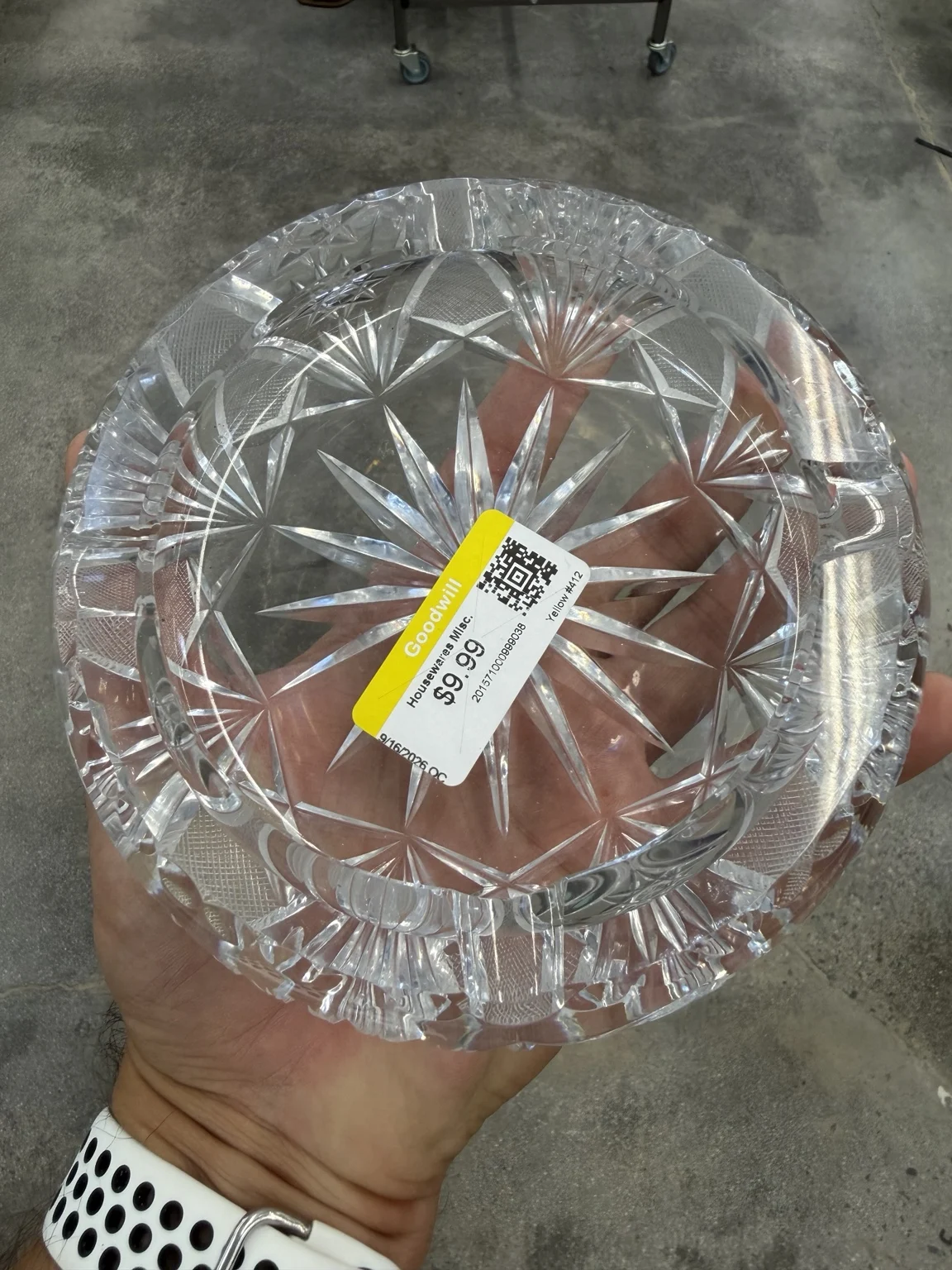
That is where I found it: a giant, glittering ashtray with a yellow Goodwill sticker reading $9.99.
It was not a lightweight piece of ordinary glass. It filled most of my hand. The walls were extraordinarily thick, the base was even thicker, and the whole thing had the dense, almost comical weight of an object designed never to move. Deep starbursts and geometric cuts caught the fluorescent store lights and broke them into little flashes of color.
It looked expensive. It felt expensive. And yet it was sitting in the housewares section for less than the price of lunch.
When an Ashtray Was Furniture
Today, an ashtray can feel like archaeological evidence from a vanished civilization. In the middle of the 20th century, however, smoking was woven into ordinary life. People smoked in homes, offices, restaurants, hotel lobbies, airplanes and television studios. A living room without an ashtray could seem as incomplete as one without a lamp.
The finest examples were not treated as disposable accessories. They were heavy pieces of decorative glass or crystal, meant to live permanently on a coffee table, executive desk or home bar. The deep cuts, polished surfaces and sheer mass transformed an unpleasantly practical object into a display of craftsmanship.
Luxury crystal houses made elaborate tabletop pieces for wealthy customers, and the material itself delivered a message. This was not a tin tray hidden in a drawer. It was clear, brilliant and deliberately overbuilt. When a guest rested a cigarette on its rim, the host’s money and taste were already visible underneath it.
The Goodwill piece has exactly that old-world confidence. Its deep bowl is surrounded by broad cigarette rests. Its sides are carved with fans, diamonds and star patterns. Seen from below, the design explodes outward like a frozen firework.
And then there is the thickness. Turn it sideways and it resembles a transparent fortress. Much of its apparent size is solid material, especially in the base and rim. That thickness explains the surprising weight and the feeling that it could survive several generations of owners.
When Smoking Borrowed the Language of Health
Smoking was never healthy, but for decades it was marketed as glamorous, calming and even compatible with good health. Cigarette advertisements frequently used doctors, white coats and medical-sounding claims to reassure buyers.
That history is important because it explains why an expensive ashtray could once seem sophisticated rather than disturbing. Cigarettes appeared in movies, business meetings and fashionable parties. The ashtray became part of the costume of success—along with the tailored suit, the cocktail glass and the polished wooden desk.
The great reversal accelerated in 1964, when the first report of the U.S. Surgeon General’s Advisory Committee on Smoking and Health concluded that cigarette smoking caused lung cancer and laryngeal cancer in men, was a probable cause of lung cancer in women and was the most important cause of chronic bronchitis. The report drew on more than 7,000 scientific articles.
What had been sold as elegance was increasingly recognized as addiction and disease. Health warnings followed. Cigarette advertising disappeared from American radio and television. Smoking restrictions expanded, and the social meaning of the ashtray began to collapse.
From Every Table to Almost No Table
Walk into a typical Walmart or Target today and you can find candles, vases, picture frames and every imaginable kind of storage container. A grand crystal ashtray is unlikely to occupy precious shelf space. The object has become too specialized, too culturally awkward and, for many households, completely useless.
That is the strange fate of changing technology and changing morals. Some antiques become more valuable because their original world disappears. Others lose value because the habit that justified them disappears too.
A heavy ashtray may have required skilled cutting, a great deal of material and real manufacturing effort. None of that guarantees that a modern buyer wants cigarette ash in the living room. Its craftsmanship survives, but its purpose has evaporated.
The Goodwill price tag makes the entire story visible in one glance: $9.99. An object once built to project permanence and sophistication is now classified simply as “Housewares Misc.”
Is It Really Crystal?
The photographs do not show a visible maker’s mark, so it would be irresponsible to claim that this is Baccarat, Waterford or another famous brand. It may be lead crystal, ordinary cut glass or a later crystal-style decorative piece. A collector would examine the weight, clarity, sound, cutting and any faint etched signature before assigning a maker or serious value.
But uncertainty about the manufacturer does not weaken the object’s cultural power. Even if it came from an anonymous factory, it was designed to imitate the language of luxury: brilliant facets, massive proportions and a base thick enough to magnify the hand beneath it.
That thickness is its most memorable feature. Modern products are often engineered to use less material and ship cheaply. This ashtray seems to come from the opposite philosophy: use more glass, add more weight and make a small tabletop object feel monumental.
Almost Worthless, Still Beautiful
There is an irony in finding it while unemployed. The rich once bought objects like this to prove they had arrived. I found one at Goodwill after losing my job, and I could afford it with a ten-dollar bill.
Time has performed a kind of economic magic. It took a symbol associated with money, leisure and adult sophistication and turned it into a nearly useless bargain. The smoking culture around it has rightly faded, but the object remains—too heavy to ignore and too beautiful to dismiss.
Perhaps its best second life has nothing to do with cigarettes. It could hold keys, coins, wrapped candy or nothing at all. It could simply sit on a shelf and scatter sunlight across the room. An ashtray without ash becomes a piece of sculpture.
That may be the most honest way to appreciate it. We do not have to admire the habit it served. We can admire the workmanship, remember how quickly society can change and smile at the absurd journey from a wealthy living room to a Goodwill sticker.
For $9.99, you are not buying permission to smoke. You are buying a thick, heavy fragment of history—a glittering reminder that luxury is temporary, usefulness is negotiable and even the strongest status symbol can eventually end up in the thrift-store housewares aisle.