A national inflation number can look tidy. A household bill rarely does.
As Americans head toward the next consumer-price report, the latest available figures offer a useful reminder: the average price increase is not a promise about what any particular family will pay. For a reader trying to protect a grocery budget, plan a commute or decide whether dinner out is still affordable, the composition of spending matters as much as the headline.
The latest numbers, with the dates attached
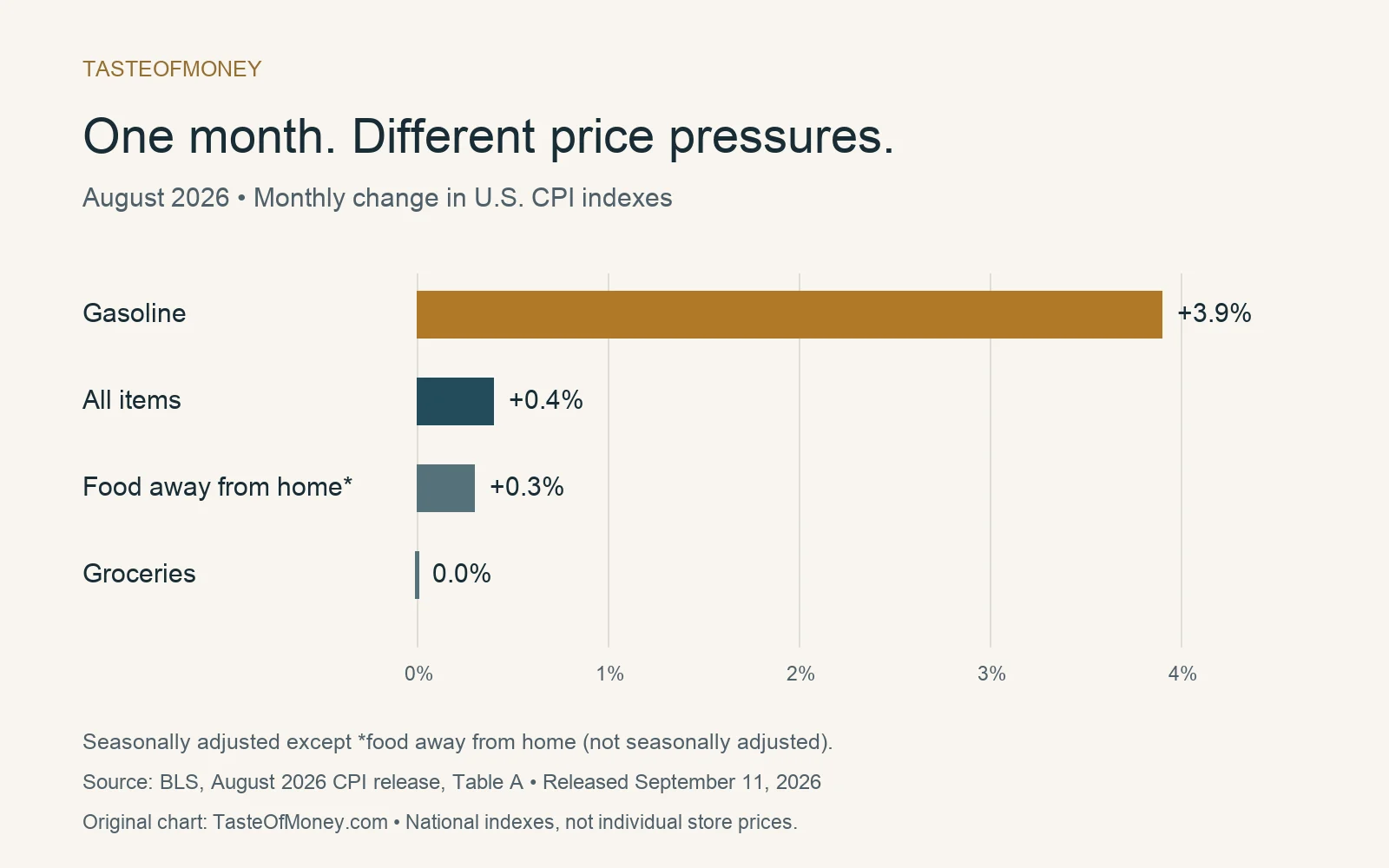
The Bureau of Labor Statistics reported that consumer prices rose 3.4% over the year ending August 2026. The monthly increase was 0.4%, seasonally adjusted. Its gasoline index rose 3.9% that month, while the grocery index was unchanged. Restaurant and other food-away-from-home prices increased 0.3%. These are national index movements, not price quotes from a particular store. [Source: BLS August CPI release](https://www.bls.gov/news.release/archives/cpi_09112026.htm).
A second federal measure points to continuing price pressure. The Bureau of Economic Analysis lists August's Personal Consumption Expenditures price index at 3.4% above a year earlier. Its September 30 release was the latest on the agency's index page when this article was researched on October 7. BEA describes PCE as a broad measure that also reflects changes in consumer behavior. [Source: BEA PCE price index](https://www.bea.gov/data/personal-consumption-expenditures-price-index).
Matching headline percentages should not tempt readers to treat these measures as identical. Nor should either number be mistaken for a forecast.
Your budget is not an average household
Consider two hypothetical households. One can walk to work and enjoys cooking at home. The other must drive a long distance and buys meals during shifts. Even before discussing income, they have different financial exposure.
The point is not that one household has made better choices. A commute may be a condition of keeping a job. A purchased meal may be the practical answer to a difficult schedule. A spending category that looks optional on a spreadsheet can feel compulsory in daily life.
That is why a broad inflation headline is a starting point for understanding a budget, rather than a verdict on whether someone's complaints are justified. It cannot tell us which bill is causing the most strain in a particular kitchen.
Luxury begins with room to maneuver
TasteOfMoney often looks at luxuries with obvious price tags. But another kind of luxury is the ability to change plans without immediately worrying about the cost.
Imagine being able to absorb a higher fuel bill without canceling something else. Or choosing a restaurant because the food sounds appealing, rather than calculating what will remain for the rest of the week. Those are hypothetical examples, but they illustrate a useful distinction: wealth can buy flexibility as well as expensive objects.
For a tightly balanced household, the same purchase can require negotiation. Something else has to wait. Financial breathing room is less photogenic than a prestige bottle of wine, yet it can be the more valuable possession.
Watch the receipt as well as the report
A practical way to read the coming data is to keep two questions separate. What happened to national prices? And what happened to the purchases that matter in your own life?
For personal comparison, consider checking receipts for the same items, quantities and sizes across time. A larger total after buying more food is not, by itself, evidence that prices rose. Conversely, a smaller basket can conceal the fact that maintaining the previous shopping list would cost more.
This is an observation method, not a claim that any individual reader's prices have moved by a particular amount. The goal is to replace an uneasy impression with a comparison you can actually examine.
The next checkpoint
BLS schedules the September CPI release for October 14, 2026, at 8:30 a.m. Eastern. That report will describe September; it will not establish every price being charged in October. [Source: BLS release schedule in the August report](https://www.bls.gov/news.release/archives/cpi_09112026.htm).
Until then, the honest story is about the latest verified data and its limits. A national average gives the economy a number. A household still has to decide what fits in the cart.
Editorial note: This article combines verified government statistics with explicitly hypothetical examples and TasteOfMoney commentary. No interviews, shopping visits or individual price quotes are claimed.