A house can get cheaper while the cost of buying it gets more expensive. That uncomfortable combination is worth keeping in mind as mortgage rates rise: the asking price is only one part of what a financed home costs.
Freddie Mac’s October 8, 2026 update puts the average 30-year fixed mortgage rate at 7.40%, compared with 7.28% a week earlier. For buyers working with a monthly budget, even a small change in financing deserves attention beside the listing price.
A seventh weekly increase changes the affordability conversation
The Associated Press reports that this was the seventh consecutive weekly increase, with the average reaching its highest level in nearly three years. Its report places the comparable rate a year earlier at 6.30%.
Those numbers describe a national benchmark. They should not be mistaken for a guaranteed offer to a particular borrower. The useful question is how a proposed purchase looks at the actual financing terms available, rather than how attractive the property looks beside yesterday’s asking price.
There is also a distinction between a change in the weekly average and a change to an existing fixed-rate loan. The calculations below compare hypothetical new loans; they do not imply that an existing borrower’s fixed principal-and-interest payment increases when a survey rate rises.
What 7.40% means for a hypothetical $400,000 loan
Consider a fully amortizing $400,000 mortgage repaid through 360 equal monthly payments over 30 years. Using the standard amortization formula, its principal-and-interest payment at 7.40% is approximately $2,770 a month.
At 7.28%, the same calculation produces approximately $2,737. The difference is about $33 a month. Compared with 6.30%, where the payment would be approximately $2,476, the difference is roughly $294 a month.
These are original calculations using the published rates as hypothetical inputs. They exclude taxes, insurance, loan fees and other ownership costs. They assume the stated rate remains fixed for the entire term, with no extra principal payments. They are examples, not lender quotes.
The year-over-year comparison is especially revealing. A buyer can be looking at the same loan amount and still face a noticeably different monthly commitment. A property’s size, kitchen and address do not need to change for financing to alter its affordability.
Why a five-percent price cut might not be enough
Now imagine two hypothetical purchases with the same 20% down-payment percentage. The first house costs $500,000, requires $100,000 down and leaves a $400,000 loan. At 6.30%, its principal-and-interest payment is approximately $2,476.
The second house costs $475,000, a five-percent reduction. Its down payment is $95,000 and its loan is $380,000. At 7.40%, the calculated principal-and-interest payment is approximately $2,631.
The cheaper house therefore costs about $155 more each month in principal and interest under these assumptions. The buyer needs less cash for the down payment, but that benefit does not make the monthly comparison disappear.

This example does not claim that home prices nationally have fallen five percent. It isolates two moving parts so readers can see the arithmetic. A real property comparison would also involve its condition, location, taxes and ongoing expenses.
The payment on the calculator is only the starting point
The Consumer Financial Protection Bureau explains that principal and interest do not capture the full monthly cost of homeownership. Its mortgage-calculator guidance identifies property taxes, homeowners insurance, mortgage insurance where applicable, and condominium or homeowners-association dues as additional considerations.
That makes a payment comparison more useful when its assumptions are written down. Two attractive numbers can describe different things if one includes taxes and insurance and the other leaves them out.
For a household comparing homes, the practical exercise is to assemble the same categories for each property. Then the decision concerns the money leaving the household each month, as well as the initial cash needed to complete the purchase.
Bank-stock pullbacks need a careful explanation
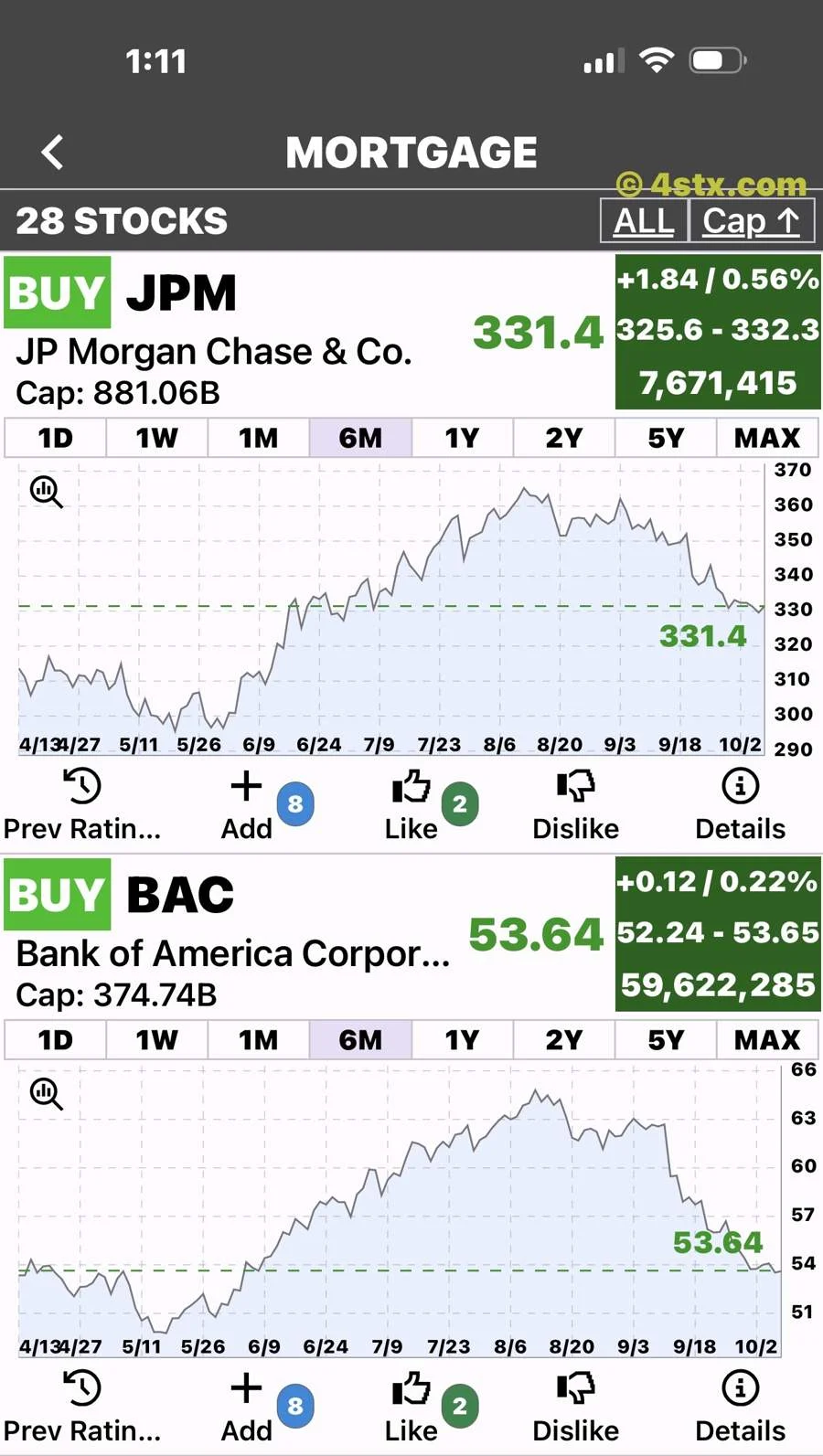
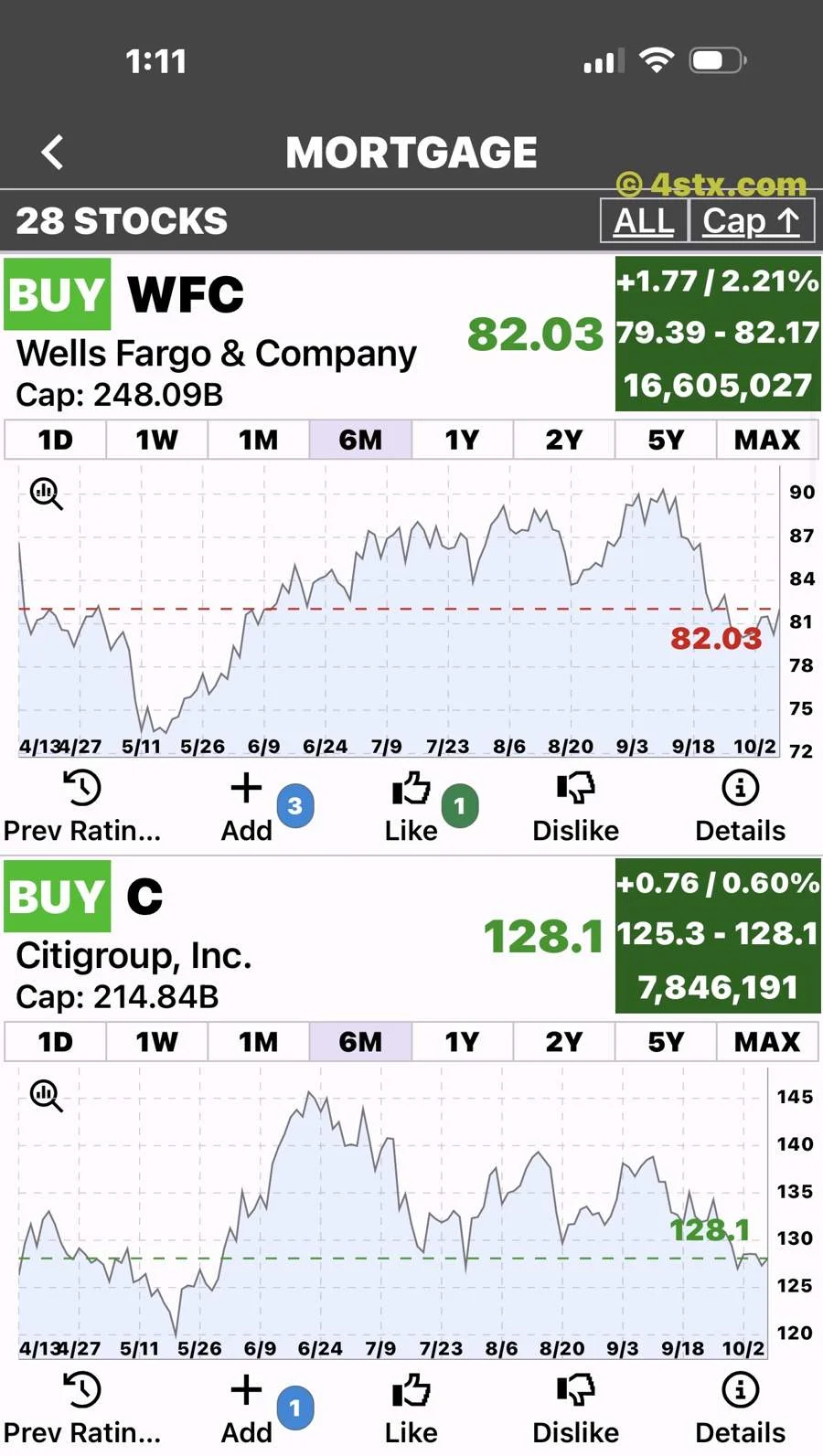
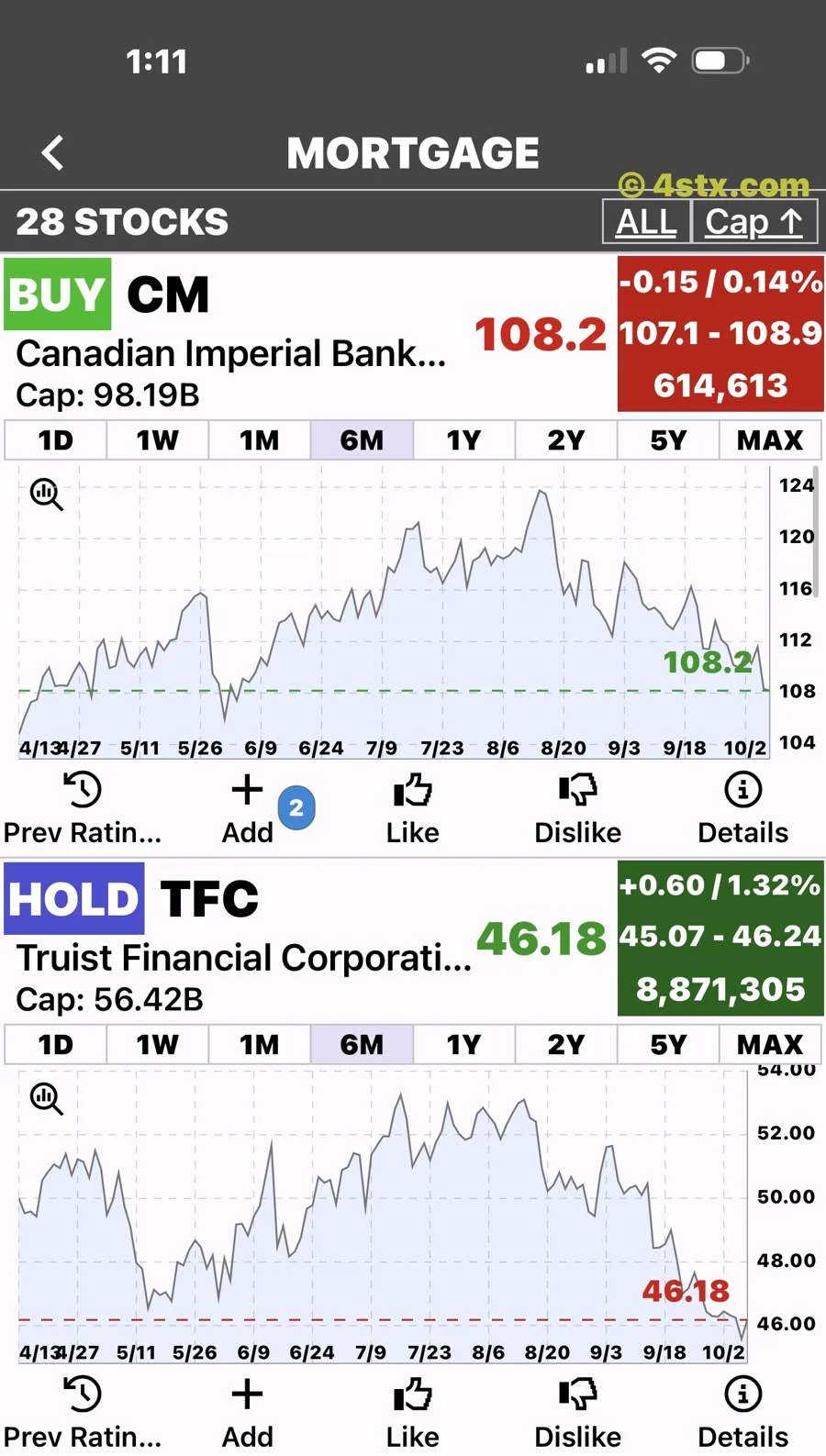
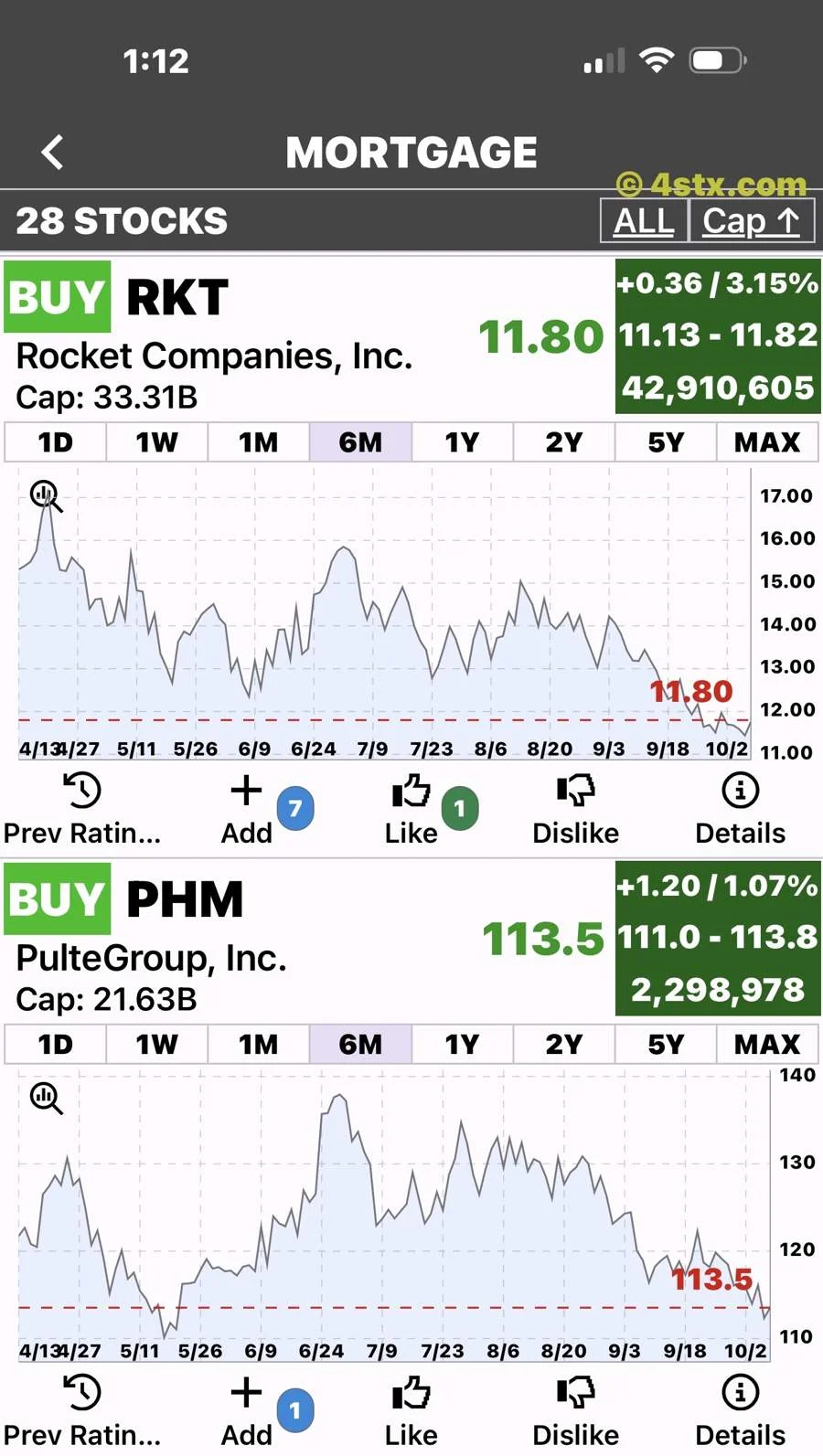
The supplied StockRank screenshots show six-month charts for JPMorgan Chase, Bank of America, Wells Fargo, Citigroup, Canadian Imperial Bank of Commerce and Truist. Each finishes below an earlier high in the displayed window. That illustrates pullbacks from peaks, rather than proving that all these stocks fell over the entire six months.
The daily change panels tell a different story: JPMorgan shows +0.56%, Bank of America +0.22%, Wells Fargo +2.21%, Citigroup +0.60% and Truist +1.32%; Canadian Imperial shows -0.14%. These are user-provided screen readings, not independently verified closing prices. The capture date and exchange timezone are not established by the images, so they should not be labeled October 8 closing data.
The fourth screenshot shows Rocket Companies and PulteGroup. They belong to the housing discussion, but they are not two additional big banks. Their displayed daily changes are also positive, even though their charts show declines from earlier highs.
Higher borrowing costs can weigh on demand for loans. However, Federal Reserve research also explains that rising rates can benefit banks’ net interest income, while deposit costs and other funding pressures can offset that benefit. The effect depends on the bank and its balance sheet.
The screenshots alone cannot establish that these share-price pullbacks happened because banks were unable to lend at high interest rates. Verifying that explanation for an individual company would require dated market data and evidence about its loan originations, funding costs and earnings. The charts are useful context for the affordability story, not proof of a single cause. StockRank’s BUY and HOLD labels are the app’s assessments, not recommendations from this article.
A discount needs to survive the financing calculation
A lower sticker price can still be valuable. The point of today’s rate news is that the discount needs to be evaluated together with the loan.
The arithmetic does not predict where rates or property prices will go next. It shows why the word “cheaper” needs a definition. Less money at closing, a lower purchase price and a lower monthly payment are three separate advantages. A purchase can offer one without delivering all three.